

FGI UPDATE: This Week’s Summary of U.S. News
FGI Expert Insights
FGI Attorney and Partner, Matt Morse, recently authored an article on the “Impact of the Second Trump Administration on the EB-1A (Alien of Extraordinary Ability) Green Card Category.” The article discusses the recent history of the EB-1A visa, adjudicatory trends, and issues involving the Final Merits Determination practice, among other topics.
To read the full article, please click this link.
Department of State Issues Visa Bulletin for August 2026
On July 19, 2026, the U.S. Department of State (DOS) issued its monthly Visa Bulletin for August 2026. USCIS has chosen the Final Action Dates chart for employment-based applications for July 2026 to determine eligibility.
USCIS will accept employment-based adjustment of status applications in August 2026 only from foreign nationals whose priority date is earlier than the applicable Final Action Date listed in the State Department’s Visa Bulletin.
Summary
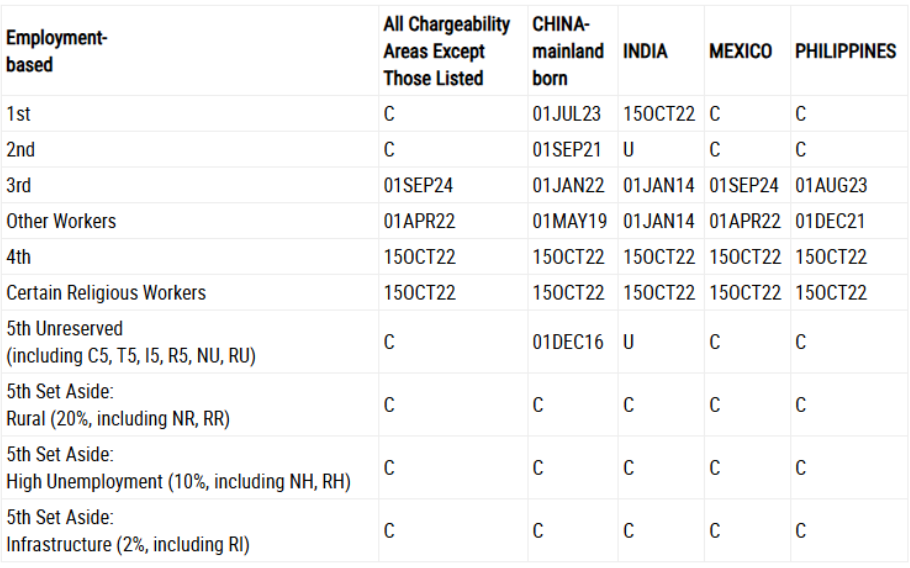
The August 2026 Visa Bulletin continues to show significant differences in employment-based immigrant visa availability by country of chargeability. EB-1 remains current for most countries but is backlogged for China (July 1, 2023) and India (October 15, 2022). EB-2 is current for most countries, while China remains backlogged (September 1, 2021) and India is unavailable due to exhausted visa numbers. EB-3 remains current only through September 1, 2024 for most countries, with substantial backlogs for China (January 1, 2022), India (January 1, 2014), the Philippines (August 1, 2023), and the Other Workers category. In EB-5, unreserved visas remain current for most countries, but China continues to face significant backlogs (December 1, 2016), and India is unavailable. The Dates for Filing chart remains more favorable than the Final Action Dates for many China and India applicants, potentially allowing earlier adjustment filings if USCIS authorizes its use for August.
Final Action Dates for August 2026
- EB-1
China: Date advances one month to July 1, 2023
India: Date remains at October 15, 2022
All other countries: Current - EB-2
China: Date remains at September 1, 2021
India: EB-2 Not available until new fiscal year (October 1, 2026)
All other countries: Current
- EB-3 Professionals and Skilled Workers
China: Date advances one week to January 1, 2022
India: Date remains at January 1, 2014
Mexico: Date advances one month to September 1, 2014
Philippines: Date remains at August 1, 2023
All other countries: Date advances one month to September 1, 2024.
- EB-3 Other Workers
China: Date advances one month to May 1, 2019
India: Date remains at January 1, 2014
Mexico: Date advances one month to April 1, 2022
Philippines: Date remains at December 1, 2021
All other countries: Date advances one month to April 1, 2022
- EB-5 Unreserved (Regional Center and Non-Regional Center)
China: Date advances ten weeks to December 1, 2016
India: Unauthorized – Numbers are not authorized for issuance.
All other countries: Current.
Final Action Dates Chart – August 2026
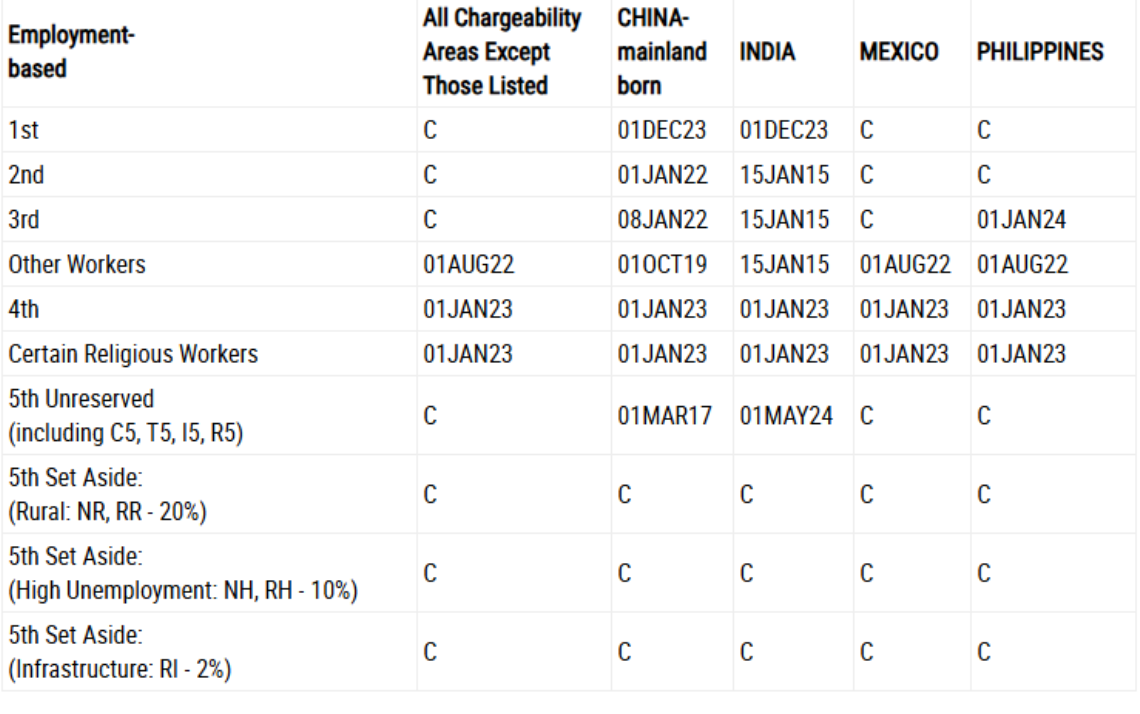
Dates for Filing for August 2026
- EB-1
China: Date remains at December 1, 2023
India: Date remains at December 1, 2023
All other countries: Current - EB-2
China: Date remains at January 1, 2022
India: Remains at January 15, 2015,
All other countries: Current - EB-3 Professionals and Skilled Workers
China: Advances one week to January 8, 2022
India: Date remains at January 15, 2015
Philippines: Date remains at January 1, 2024.
All other countries: Current
- EB-3 Other Workers
China: Date remains at October 1, 2019
India: Date remains at January 15, 2015
Mexico: Date remains at August 1, 202
Philippines: Date remains at August 1, 2022
All other countries: Date remains at August 1, 2022
- EB-5 Unreserved (Regional Center and Non-Regional Center)
China: Date remains at March 1, 2017
India: Date remains at May 1, 2024
All other countries: Current
Dates for Filing Chart – August 2026
SOURCE: travel.state.gov/content/travel/en/legal/visa-law0/visa-bulletin/2026/visa-bulletin-for-august-2026.html
U.S. Reaches FY 2027 H-1B Cap: No Second Lottery Will Be Held
The U.S. Citizenship and Immigration Services (USCIS) has announced that it has received enough H-1B petitions to meet the Fiscal Year (FY) 2027 annual cap of 85,000 visas. Because the cap has been reached, USCIS will not conduct a second H-1B lottery this year. Employers whose selected beneficiaries submitted petitions by the June 30, 2026, filing deadline will continue through the adjudication process, while employers whose registrations were not selected will need to consider other immigration options for affected employees.
Key Points
- FY 2027 H-1B Cap Has Been Reached: USCIS confirmed that it received enough petitions to satisfy both the regular H-1B cap of 65,000 visas and the additional 20,000 visas available under the U.S. advanced degree exemption. This officially closes the FY 2027 cap season.
- No Second Lottery Will Occur: Because enough petitions were filed by the June 30 filing deadline, USCIS will not conduct a second H-1B cap lottery for FY 2027. Only beneficiaries whose registrations were previously selected will have cap-subject petitions considered for this fiscal year.
- Petition Filing Period Has Ended: Employers selected during the initial registration process were required to submit complete H-1B petitions by June 30, 2026. USCIS determined that the number of timely filed petitions was sufficient to exhaust the annual quota without additional selections.
- Alternative Immigration Strategies May Be Necessary: Employers whose beneficiaries were not selected under the H-1B cap will need to evaluate other work authorization options where available. Depending on the employee’s circumstances, these alternatives may include cap-exempt H-1B employment, treaty-based visas, O-1 classification, STEM OPT extensions, or employment-based permanent residence.
What Employers Need to Know
- Selected Cases Continue Through Adjudication: Employers that timely filed H-1B petitions for selected beneficiaries should continue monitoring USCIS processing and respond promptly to any Requests for Evidence (RFEs) or other agency notices. Reaching the cap does not guarantee approval, as each petition must still satisfy all eligibility requirements.
- Unselected Beneficiaries Need Immediate Planning: Organizations employing individuals whose registrations were not selected should evaluate alternative immigration strategies as early as possible. Early planning can help minimize employment interruptions and preserve workforce continuity.
- Future Workforce Planning Remains Critical: Employers should continue identifying H-1B candidates well before the next registration season and assess whether alternative visa categories or permanent residence strategies may better support long-term staffing needs. Advance planning is increasingly important in a competitive and evolving immigration environment.
Looking Ahead
- Attention Will Shift to FY 2028: With the FY 2027 cap process complete, employers should begin preparing for the next H-1B registration cycle and monitor USCIS announcements regarding registration dates and procedural requirements. Early preparation remains one of the best ways to reduce last-minute filing challenges.
- Employers Should Monitor Policy Developments: The FY 2027 cap season reflected ongoing changes to H-1B administration, and additional regulatory or procedural updates could affect future filing strategies. Employers should stay informed as USCIS continues refining the H-1B selection and adjudication process.
- Competition for H-1B Numbers Is Expected to Continue: Although the FY 2027 filing process has concluded, demand for H-1B visas is likely to remain strong in future years. Employers should continue developing long-term talent acquisition and immigration strategies that account for the annual numerical limitations.
In reaching the FY 2027 H-1B cap, USCIS has concluded this year’s cap-subject filing process without the need for a second lottery. Employers with pending petitions should focus on successful adjudication of those cases, while employers with unselected beneficiaries should promptly evaluate alternative immigration pathways and begin preparing for the next H-1B cap season.
Department of Homeland Security Replaces Public Charge Regulation with Policy Guidance and Broader Adjudicator Discretion
The Department of Homeland Security (DHS) has finalized a rule rescinding the 2022 public charge regulation and replacing it with policy guidance that gives immigration officers broader discretion when determining whether an applicant is likely to become a public charge. Rather than relying on detailed regulatory standards, adjudicators will make individualized determinations based on the totality of an applicant’s circumstances. The revised approach is expected to lower the threshold for finding that an applicant is likely to become a public charge, resulting in greater scrutiny during green card and other admissibility adjudications while creating additional uncertainty for applicants and employers.
Key Points
- 2022 Public Charge Rule Has Been Rescinded: DHS has eliminated the 2022 public charge regulation and replaced it with policy guidance instead of detailed regulatory criteria. This change restores broader discretion for immigration officers when evaluating whether an applicant is likely to become primarily dependent on government assistance.
- Adjudicators Have Greater Decision-Making Authority: Immigration officers will now make public charge determinations based on the totality of each applicant’s circumstances rather than following a more structured regulatory framework. As a result, officers may weigh a broader range of positive and negative factors when deciding whether an applicant is admissible.
- Higher Levels of Scrutiny Are Expected: The new policy guidance is expected to lower the threshold for finding that an applicant could become a public charge. Applicants may therefore face more extensive review of their financial resources, health, education, employment history, and other factors that relate to self-sufficiency.
- Greater Uncertainty May Result: Because the guidance relies more heavily on officer judgment than detailed regulations, outcomes may become less predictable from case to case. Applicants and their representatives may encounter greater variation in adjudications depending on the facts presented and the reviewing officer’s assessment.
What Employers Need to Know
- Employment-Based Applicants May Face Increased Review: Although employment-based immigrants often have convincing evidence of financial self-sufficiency, employers should expect officers to examine supporting documentation more closely. Complete and well-documented petitions may become increasingly important under the revised framework.
- Case Preparation Should Be More Thorough: Employers should work with foreign national employees to ensure applications contain comprehensive evidence demonstrating financial stability and the ability to remain self-supporting. Strong documentation may help reduce questions arising from the broader discretionary standard.
- Expect Less Predictability in Adjudications: Because officers now have greater discretion, similarly situated applicants may experience different outcomes depending on how individual circumstances are evaluated. Employers should plan for potential delays, Requests for Evidence (RFEs), or additional documentation requests in affected cases.
Looking Ahead
- Additional Policy Guidance May Be Issued: DHS and USCIS may publish further interpretive guidance explaining how officers should apply the revised public charge framework. Future guidance could clarify evidentiary expectations but is unlikely to eliminate the expanded discretion granted to adjudicators.
- Litigation and Policy Challenges Are Possible: As with prior public charge policies, the new framework may face legal challenges from states and advocacy organizations. Court decisions could affect implementation or result in additional changes to the policy over time.
- Employers Should Continue Monitoring Developments: Organizations sponsoring foreign nationals should stay informed about additional DHS and USCIS guidance regarding public charge determinations. Ongoing monitoring will help employers and applicants adapt to evolving adjudication standards and documentation expectations.
The rescission of the 2022 public charge regulation represents a significant shift in how DHS will evaluate admissibility for many immigration applicants. By replacing detailed regulations with broader policy guidance and expanded officer discretion, the government is expected to increase scrutiny of public charge determinations while making adjudication outcomes less predictable, underscoring the importance of careful case preparation and thorough supporting documentation.
Federal Court Temporarily Blocks State Department Visa Policy Targeting Content Moderation Work
A federal district court in Washington, D.C., has temporarily blocked part of a U.S. Department of State policy that allowed visa officers to deny or revoke visas based on a foreign national’s work involving content moderation, misinformation, disinformation, fact-checking, trust and safety, or similar activities. The court’s temporary stay prevents the government from enforcing this portion of the policy while it considers the underlying legal challenge. The ruling does not invalidate the entire policy but temporarily halts enforcement of the provision affecting individuals engaged in these types of professional activities.
Key Points
- Court Temporarily Blocks Enforcement: The U.S. District Court for the District of Columbia has temporarily stayed the State Department’s policy allowing visa denials or revocations based on certain content moderation-related activities. The stay will remain in effect while the court considers the merits of the lawsuit challenging the policy.
- Policy Targeted Content Moderation Activities: The challenged policy permitted consular officers to consider an individual’s research, reporting, advocacy, fact-checking, misinformation or disinformation work, content moderation, compliance, or trust and safety activities when making visa decisions. The policy had been in effect since December 2025 as part of the administration’s broader efforts to address perceived censorship of online speech.
- Lawsuit Raises Constitutional Concerns: The plaintiffs argue that the policy unlawfully penalizes foreign nationals based on protected speech and professional activities. The court concluded that the plaintiffs demonstrated sufficient grounds to temporarily halt enforcement while the litigation proceeds.
- Litigation Will Continue: The court’s order is only a temporary measure and does not represent a final decision on the legality of the policy. Additional court proceedings will determine whether the challenged provisions are ultimately upheld or permanently enjoined.
What Employers Need to Know
- Affected Employees May Receive Temporary Relief: Employers with foreign national employees or applicants whose work involves content moderation, online safety, compliance, fact-checking, or related fields may benefit from the temporary suspension of the challenged policy. However, the relief is provisional and could change depending on the outcome of the litigation.
- Visa Processing May Continue to Evolve: Although this portion of the policy has been stayed, employers should recognize that visa adjudications remain subject to extensive security screening and other discretionary reviews. Organizations should continue preparing comprehensive documentation for affected employees throughout the visa application process.
- Monitor Pending Litigation Closely: Because the case remains active, employers should stay informed about future court rulings and any updated State Department guidance. Changes in the litigation could directly affect visa eligibility and adjudication standards for employees working in technology, social media, cybersecurity, artificial intelligence, and digital trust and safety roles.
Looking Ahead
- Further Judicial Review Is Expected: The district court will continue considering the legal and constitutional issues raised in the lawsuit before issuing a final ruling. Either party may also appeal future decisions, potentially extending the litigation.
- State Department Policies Could Change Again: Depending on the outcome of the case, the State Department may revise or replace the challenged guidance to address the court’s concerns while continuing its broader vetting objectives. Additional agency guidance may also clarify how consular officers should evaluate applicants engaged in online content-related professions.
- Technology Employers Should Remain Vigilant: Companies employing professionals in trust and safety, content moderation, misinformation research, compliance, or related technology fields should continue monitoring immigration policy developments. Ongoing legal challenges could significantly affect international hiring, employee mobility, and visa planning for these specialized occupations.
The federal court’s temporary stay represents an important development for foreign nationals whose professional work involves content moderation and related online safety activities. Although the challenged State Department policy has been paused for now, the litigation remains ongoing, and employers and affected employees should continue monitoring the case closely as it may shape future visa adjudication standards in this evolving area of immigration policy.
State Department Launches Pilot Program for Expedited Nonimmigrant Visa Appointments
The U.S. Department of State has launched a pilot program that allows certain B-1/B-2 visitor visa applicants to pay an additional fee to receive an earlier visa interview appointment at participating U.S. embassies and consulates. The program only expedites the scheduling of the interview and does not guarantee visa approval or faster visa processing after the interview. Applicants participating in the pilot remain subject to the same eligibility requirements, security screening, and consular adjudication standards as all other visa applicants.
Key Points
- Expedited Appointment Pilot Program Introduced: The State Department’s pilot program allows eligible B-1/B-2 visa applicants to obtain an earlier interview appointment at participating consular posts by paying an additional expedited appointment fee. The program is intended to improve access to interview appointments for travelers with business or tourism needs while testing demand for expedited scheduling.
- Earlier Interview Only—Not Faster Adjudication: The expedited service only accelerates the scheduling of the visa interview and does not provide priority processing after the interview takes place. Every applicant must still complete the same screening, security vetting, and eligibility review required under U.S. immigration law before a visa can be issued.
- Participation Is Limited: The pilot program is available only at selected U.S. embassies and consulates and is subject to appointment availability. Eligible applicants who choose not to pay the additional fee may continue using the standard visa appointment process.
- Existing Eligibility Requirements Remain Unchanged: Paying for an expedited appointment does not improve an applicant’s chances of obtaining a visa. Consular officers will continue applying the same statutory eligibility requirements and discretionary standards during every visa interview.
What Employers Need to Know
- Business Travelers May Benefit: Employers with employees who require short notice travel to the United States for meetings, conferences, negotiations, training, or other temporary business activities may find the expedited appointment option helpful. The program may reduce delays in securing interview appointments when available at participating posts.
- The Program Does Not Guarantee Travel: Employers should recognize that an earlier interview appointment does not guarantee visa issuance or entry into the United States. Employees must still satisfy all applicable visa eligibility requirements and successfully complete the standard adjudication process.
- Travel Planning Should Continue Well in Advance: Although the pilot provides an additional scheduling option, appointment availability remains limited, and demand may be high. Employers should continue planning international business travel as early as possible and avoid relying solely on expedited appointments to meet critical business deadlines.
Looking Ahead
- Program Performance Will Be Evaluated: The State Department is expected to monitor participation rates, appointment availability, and operational impacts before deciding whether to expand, modify, or discontinue the pilot. The results may influence future visa appointment scheduling policies across the global consular network.
- Additional Participating Posts May Be Announced: As the pilot progresses, the State Department may identify additional embassies and consulates that will offer expedited appointments. Applicants should monitor official State Department announcements for updates regarding participating locations and program availability.
- Standard Vetting Will Remain a Priority: Even if expedited appointment programs expand in the future, the Department of State has emphasized that all applicants will continue to undergo comprehensive security screening and eligibility reviews before visas are issued. Faster scheduling is intended to improve access to appointments without changing the underlying adjudication process.
The new expedited appointment pilot program provides certain B-1/B-2 visa applicants with an optional way to obtain earlier interview appointments while preserving the integrity of the visa adjudication process. Although the initiative may improve travel planning for businesses and individuals facing tight schedules, employers and applicants should remember that the program expedites only the interview appointment and does not affect visa eligibility, security screening, or the likelihood of approval.