

FGI UPDATE: This Week’s Summary of U.S. Immigration News
Department of State Releases Visa Bulletin for March 2026
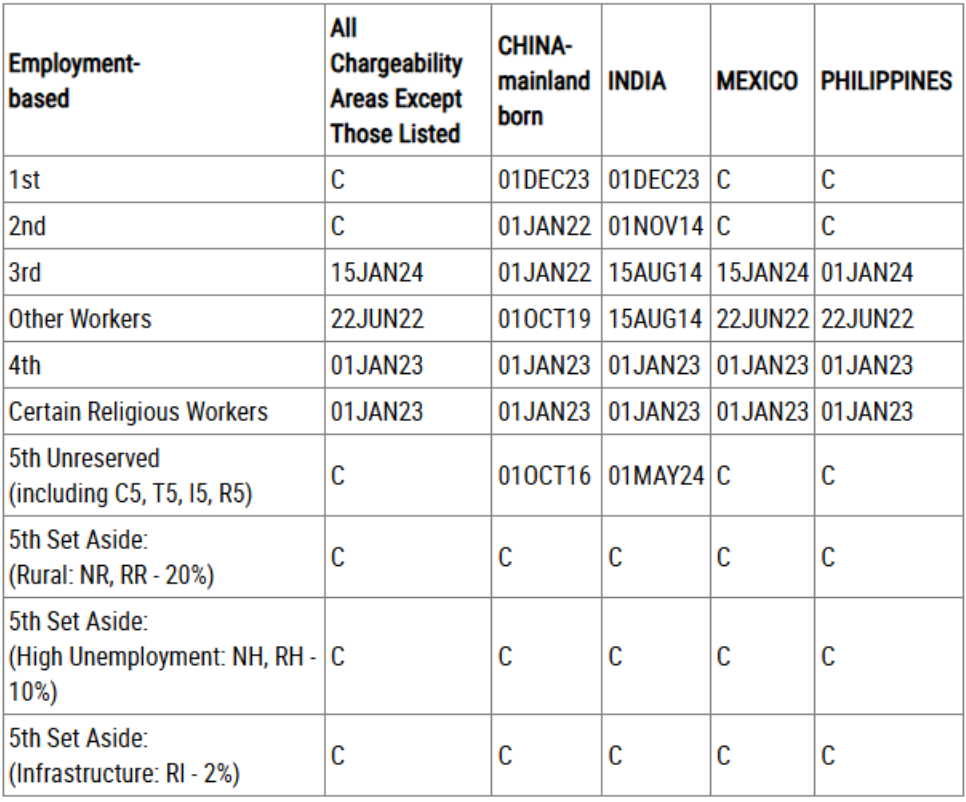
On February 19, 2026, the U.S. Department of State (DOS) issued its monthly Visa Bulletin for March 2026. USCIS has chosen the Dates for Filing chart for employment-based applications for March 2026 to determine eligibility.
USCIS will accept employment-based adjustment of status applications from foreign nationals with a priority date that is earlier than the applicable Date for Filing listed in the State Department’s March 2026 Visa Bulletin.
Dates for Filing for March 2026
EB-1
China: Date advances four months to December 1, 2023
India: Date advances four months to December 1, 2023
All other countries: Current
EB-2
China: Date remains at January 1, 2022
India: Date advances eleven months to November 1, 2014
All other countries: Current
EB-3 Professionals and Skilled Workers
China: Date remains at January 1, 2022
India: Date remains at August 15, 2014
Philippines: Date advances three months to January 1, 2024.
All other countries: Date advances three and a half months to January 15, 2024.
EB-3 Other Workers
China: Date remains at October 1, 2019
India: Date remains at August 15, 2014
All other countries: Date advances six months to June 22, 2022
EB-5 Unreserved (Regional Center and Non-Regional Center)
China: Date advances five weeks to October 1, 2016
India: Date remains at May 1, 2024
All other countries: Current
EB-5 Set-Asides
Rural: Current for all countries
High Unemployment: Current for all countries
Infrastructure: Current for all countries
Dates for Filing Chart – March 2026
Final Action Dates for March 2026
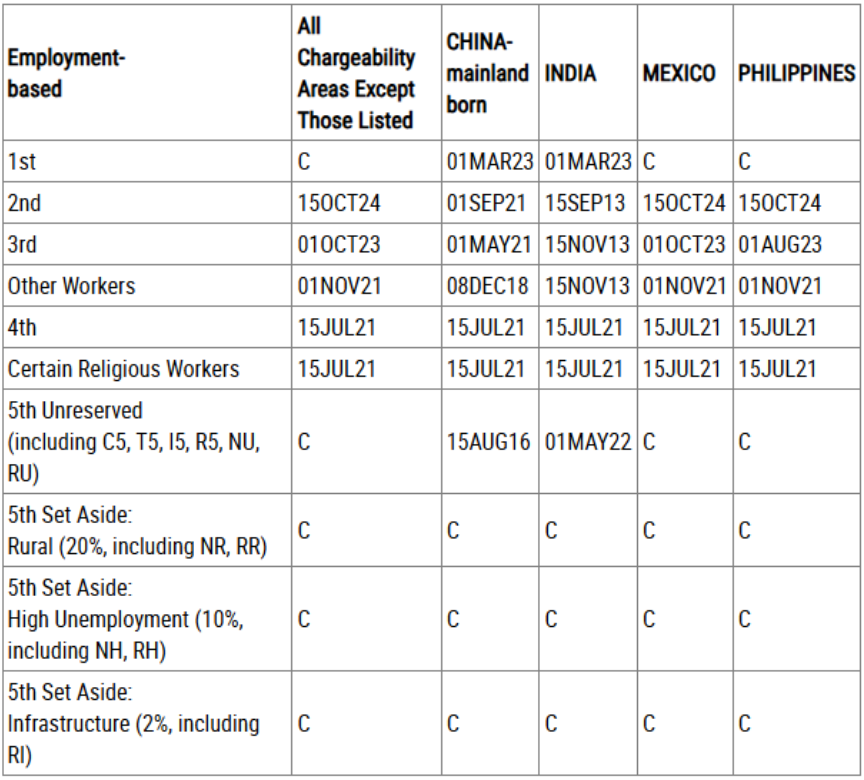
EB-1
China: Date advances one month to March 1, 2023
India: Date advances one month to March 1, 2023
All other countries remain current
EB-2
China: Date remains at September 1, 2021
India: Date advances two months to September 15, 2013
All other countries: Date advances six and a half months to October 15, 2024.
EB-3 Professionals and Skilled Workers
China: Date remains at May 1, 2021
India: Date remains at November 15, 2013
Philippines: Date advances two months to August 1, 2023
All other countries: Date advances four months to October 1, 2023.
EB-3 Other Workers
China: Date remains at December 8, 2018
India: Date remains at November 15, 2013
All other countries: Date advances two months to November 1, 2021
EB-5 Unreserved (Regional Center and Non-Regional Center)
China: Date remains at August 15, 2016
India: Date remains at May 1, 2022.
All other countries remain Current.
EB-5 Set-Asides
Rural: Current for all countries
High Unemployment: Current for all countries
Infrastructure: Current for all countries
Final Action Dates Chart – March 2026
SOURCE: travel.state.gov/content/travel/en/legal/visa-law0/visa-bulletin/2026/visa-bulletin-for-march-2026.html
OFLC Releases Q1 FY2026 Public Disclosure Data and Program Statistics
The U.S. Department of Labor’s Office of Foreign Labor Certification (OFLC) has released detailed public data covering the first quarter of fiscal year 2026 (October 1, 2025, through December 31, 2025). The data includes final decisions on employer applications for prevailing wage determinations and labor certifications across major employment-based visa programs, including PERM, LCA (H-1B, H-1B1, E-3), H-2A, H-2B, CW-1, and the Prevailing Wage program. OFLC also published selected program statistics summarizing activity during this period, giving employers and stakeholders insight into processing trends and outcomes.
Key Points
- Comprehensive Q1 Data Release – The Office of Foreign Labor Certification released public disclosure files covering the first quarter of fiscal year 2026. These files include all final determinations issued between October 1, 2025, and December 31, 2025.
- Coverage of Major Employment Visa Programs – The data spans multiple programs, including PERM and the Labor Condition Application process for H-1B, H-1B1, and E-3 classifications. It also includes filings under H-2A, H-2B, CW-1, and the Prevailing Wage program.
- Prevailing Wage and Labor Certification Decisions – The disclosure files contain employer applications requesting prevailing wage determinations and labor certifications. Each file reflects final agency decisions issued during the reporting period.
- Selected Program Statistics Published – In addition to raw data files, OFLC released selected program statistics summarizing key activity metrics for Q1 FY2026. These statistics provide a high-level snapshot of filing volumes and outcomes.
- Detailed Record Layouts Available – OFLC provided record layouts that describe each available data element in the disclosure files. This allows users to interpret and analyze the data accurately.
What US Employers Need to Know
- Transparency Into Adjudication Trends – The Q1 disclosure data allows employers to evaluate approval rates, processing volumes, and prevailing wage determinations across programs. This information can help employers benchmark their own filings and assess risk factors.
- Strategic Planning for Workforce Needs – Employers using PERM or LCA processes can review recent trends to inform recruitment timelines and sponsorship strategies. Understanding agency output during Q1 may help forecast future processing dynamics.
- Wage Compliance Insights – The Prevailing Wage data provides insight into how OFLC is evaluating wage levels and occupational classifications. Employers should review trends to ensure wage offerings remain compliant and competitive.
- Program-Specific Considerations – Employers in agriculture (H-2A), seasonal industries (H-2B), or the Commonwealth of the Northern Mariana Islands (CW-1) can assess program-specific statistics. These data points may signal shifts in demand or adjudication patterns.
- Data-Driven Compliance Reviews – The detailed record layouts make it possible for internal compliance teams to conduct sophisticated data analysis. Employers may wish to use the data to identify common denial reasons or emerging scrutiny areas.
Looking Ahead
- Monitoring Filing Volumes – Future quarterly releases may reveal whether filing volumes are increasing or stabilizing across key programs. Sustained growth could affect processing times and agency backlogs.
- Shifts in Prevailing Wage Determinations – Changes in wage determinations across quarters may influence employer budgeting and hiring decisions. Employers should monitor whether wage levels trend upward in key occupations.
- Policy or Enforcement Signals – Public disclosure data sometimes reflects broader enforcement or policy priorities. Trends in denials or audit activity could indicate evolving compliance expectations.
- Increased Data Utilization – As stakeholders increasingly analyze OFLC data, employers may face greater scrutiny from competitors, labor advocates, or regulators. Public transparency heightens the importance of accurate and defensible filings.
- Quarterly Trend Comparisons – Comparing Q1 FY2026 data to prior quarters may reveal longer-term shifts in employment-based immigration usage. Employers should incorporate these insights into strategic workforce planning.
In releasing its Q1 FY2026 public disclosure data and selected program statistics, OFLC has provided employers, researchers, and policymakers with a detailed snapshot of activity across key employment-based immigration programs. The data not only reflects final determinations issued during the first quarter of the fiscal year, but also offers valuable insight into prevailing wage trends, filing volumes, and adjudication patterns that may shape employer strategies moving forward.
SOURCE: US Department of Labor Newsroom, February 13, 2026: www.dol.gov/agencies/eta/foreign-labor/news
Reminder: USCIS Premium Processing Fees to Increase as of March 1, 2026
Starting on March 1, 2026, the U.S. Citizenship and Immigration Services (USCIS) will raise the cost of premium processing for several key employment-related petitions and applications to reflect inflation and maintain service efficiency. Premium processing is an optional service that expedites the adjudication timeline—usually to about 15 calendar days—for eligible filings, and the fee change affects common employer requests such as H-1B, I-140, OPT, and other immigration benefits. Employers, applicants, and immigration professionals are advised to prepare for the updated fees and consider filing eligible premium processing requests before March 1, 2026, to take advantage of the current fee structure.
Key Points
- Fee increases across major forms – USCIS will raise the premium processing fee for Form I-140 (employment-based immigrant worker petitions) and most Form I-129 nonimmigrant worker petitions from $2,805 to $2,965. Fees for Form I-539 and Form I-765 will also increase, rising to $2,075 and $1,780, respectively.
- Effective date and requirement – The new fee schedule takes effect for premium processing requests postmarked on or after March 1, 2026. Any request filed with an outdated fee on or after that date may be rejected and returned by USCIS.
- Inflation-based adjustment – The increases are part of a biennial inflation adjustment authorized under federal rules and last occurred in February 2024; they reflect inflation measured between June 2023 and June 2025.
- Scope of impact – Nearly all employment-related premium processing filings will be affected, including H-1B, L-1, O-1, TN, R-1, H-2B, immigrant petitions (EB-1, EB-2, EB-3), OPT/STEM OPT work authorizations, and certain status change applications.
- No effect on regular filing fees – These increases apply only to the premium processing service fee, not to the underlying USCIS filing fees, which remain unchanged under this rule.
What US Employers Need to Know
- Budgeting for increased costs – Employers sponsoring foreign workers should factor higher processing fees into their immigration budgets for 2026 and beyond. Planning ahead may help control costs, especially for firms with frequent or multiple premium processing requests.
- Timing of filings matters – To avoid paying the higher fees, employers and applicants should submit premium processing requests (Form I-907) before March 1, 2026, whenever feasible. Careful submission timing can reduce overall immigration expenditure.
- Risk of rejection if fees are incorrect – Any Form I-907 submitted with the wrong fee amount after March 1 may be rejected and returned, which can delay adjudication and require resubmission with the correct fee.
- Continued reliance on premium processing – Despite the increased cost, many employers continue to use premium processing to meet staffing deadlines, ensure work authorization continuity, and reduce risks associated with slow adjudication.
- Broader immigration planning – Employers should work with immigration counsel to update filing strategies, especially for high-volume immigration programs like H-1B, L-1, and employment-based green cards.
Looking Ahead
- Future inflation adjustments – USCIS typically adjusts premium processing fees every two years based on statutory authority to keep pace with inflation, so additional increases may occur in future cycles.
- Service performance expectations – The additional revenue from higher fees is intended to support improved adjudication capacity and efficiency, although the exact impact on processing backlogs remains to be seen.
- Evolving immigration policy landscape – Fee changes may occur alongside other USCIS regulatory updates that could affect employment-based immigration more broadly, such as visa allocation policies or adjudication priorities.
- Employer adaptation strategies – Organizations may explore alternative work authorization strategies, internal workforce planning, and earlier filing windows to mitigate cost and timing pressures from premium processing fee volatility.
- Monitoring compliance and costs – Staying abreast of future USCIS fee adjustments and policy shifts will help employers maintain compliance while optimizing immigration expenditures.
In summary, premium processing fees for key U.S. employment and immigration petitions will rise effective March 1, 2026, in an inflation-linked adjustment by USCIS, affecting forms like I-129, I-140, I-539, and I-765. Employers, foreign nationals, and immigration practitioners should consider adjusting budgets and filing strategies accordingly and may benefit from submitting eligible requests ahead of the effective date to avoid the higher costs.
SOURCE: www.uscis.gov/newsroom/alerts/uscis-to-increase-premium-processing-fees
DOS: China Not Included In Immigrant Visa Pause
The U.S. Department of State (DOS) has confirmed that China is not part of the 75-country immigrant visa processing pause that began January 21, 2026:
- The clarification follows an erroneous alert on the Travel Docs website suggesting Chinese nationals were affected.
- Immigrant visa processing for Chinese applicants continues without interruption.
SOURCE: www.aila.org/library/practice-alert-china-not-part-of-iv-pause