

FGI Update: This Week’s Summary of U.S. Immigration News
Department of State Issues Visa Bulletin for July 2026
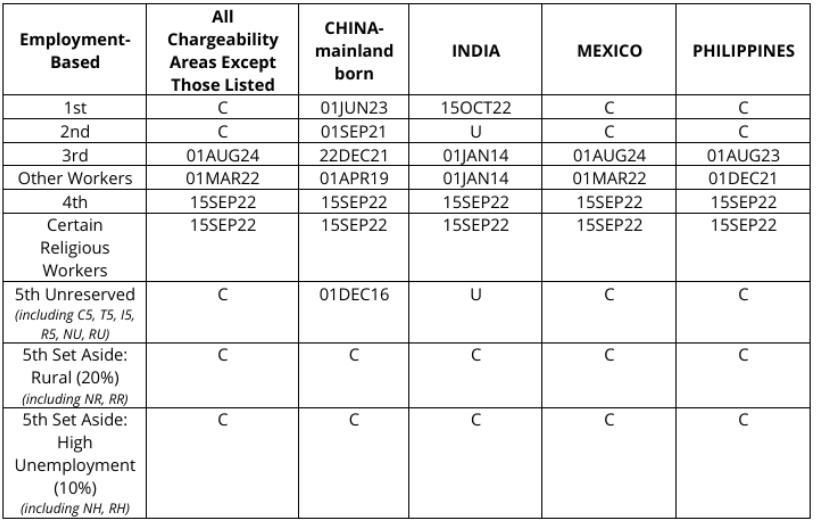
On June 19, 2026, the U.S. Department of State (DOS) issued its monthly Visa Bulletin for July 2026. USCIS has chosen the Final Action Dates chart for employment-based applications for July 2026 to determine eligibility.
USCIS will accept employment-based adjustment of status applications in July 2026 only from foreign nationals whose priority date is earlier than the applicable Final Action Date listed in the State Department’s Visa Bulletin.
Summary
The employment-based immigrant visa categories remain heavily influenced by continued demand and per-country limits, with the most significant backlogs concentrated in India and China. Employment-based first preference (EB-1) remains current for most countries, but China and India continue to experience cut-off dates, reflecting sustained demand in those categories. Employment-based second preference (EB-2) remains current for most countries except China, which remains backlogged to September 1, 2021, while India remains unavailable for final action processing this month, indicating that no visa numbers are currently available for Indian EB-2 applicants. Employment-based third preference (EB-3) continues to show meaningful retrogression for India and China, with India advancing only through January 1, 2014, and China through December 22, 2021, while most other countries remain significantly more favorable.
In the EB-5 immigrant investor category, unreserved visa numbers remain current for most countries but continue to be significantly backlogged for China and unavailable for India. By contrast, all EB-5 set-aside categories—including rural, high-unemployment, and infrastructure investments—remain current across all countries, preserving continued filing opportunities for eligible investors.
Final Action Dates for July 2026
EB-1
- China: Date advances two months to June 1, 2023
- India: Date retrogresses two months to October 15, 2022
- All other countries: Current
EB-2
- China: Date remains at September 1, 2021
- India: EB-2 Not available until new fiscal year (October 1, 2026)
- All other countries: Current
EB-3 Professionals and Skilled Workers
- China: Date advances 4.5 months to December 22, 2021
- India: Date advances two weeks to January 1, 2014
- Mexico: Date advances two months to August 1, 2014
- Philippines: Date remains at August 1, 2023
- All other countries: Date advances two months to August 1, 2024.
EB-3 Other Workers
- China: Date remains at April 1, 2019
- India: Date advances two weeks to January 1, 2014
- Mexico: Date advances one month to March 1, 2022
- Philippines: Date advances one month to December 1, 2021
- All other countries: Date advances one month to March 1, 2022
EB-5 Unreserved (Regional Center and Non-Regional Center)
- China: Date advances ten weeks to December 1, 2016
- India: Unauthorized – Numbers are not authorized for issuance.
- All other countries: Current.
Final Action Dates Chart – July 2026
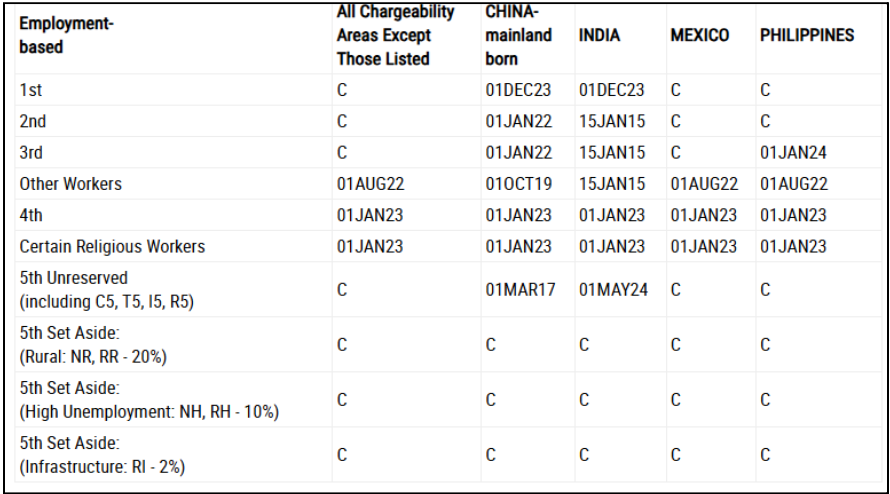
Dates for Filing for July 2026
EB-1
- China: Date remains at December 1, 2023
- India: Date remains at December 1, 2023
- All other countries: Current
EB-2
- China: Date remains at January 1, 2022
- India: Remains at January 15, 2015
- All other countries: Current
EB-3 Professionals and Skilled Workers
- China: Date remains at January 1, 2022
- India: Date remains at January 15, 2015
- Philippines: Date remains at January 1, 2024.
- All other countries: Current
EB-3 Other Workers
- China: Date remains at October 1, 2019
- India: Date remains at January 15, 2015
- Mexico: Date remains at August 1, 2022
- Philippines: Date remains at August 1, 2022
- All other countries: Date remains at August 1, 2022
EB-5 Unreserved (Regional Center and Non-Regional Center)
- China: Date remains at March 1, 2017
- India: Date remains at May 1, 2024
- All other countries: Current
Dates for Filing Chart – July 2026
SOURCE: travel.state.gov/content/travel/en/legal/visa-law0/visa-bulletin/2026/visa-bulletin-for-july-2026.html
Federal Court Rules USCIS Adjudication Hold Policies Unlawful
On June 5, 2026, the U.S. District Court for the District of Rhode Island ruled in Dorcas International Institute of Rhode Island v. USCIS that several USCIS adjudication hold policies were unlawful and vacated those policies under the Administrative Procedure Act. The decision determined that USCIS improperly suspended processing for immigration benefits—including green cards, employment authorization, naturalization, and asylum applications—through policies tied to the administration’s travel restrictions. The ruling may allow affected applications to move forward and reinforces the principle that immigration agencies must continue adjudicating cases within the authority granted by Congress.
Key Points
-
- Court Found USCIS Exceeded Its Authority: The court concluded that USCIS adopted adjudication hold policies without sufficient statutory or regulatory authority. It also found that the policies violated requirements under the Administrative Procedure Act (APA).
- Four USCIS Policies Were Vacated: The ruling invalidated four separate policies, including the benefits hold policy, a global affirmative asylum hold, a comprehensive re-review process for previously approved benefits, and policies applying additional scrutiny based on country-related factors. The court ordered these policies vacated and set aside.
- Processing Delays Impacted Multiple Immigration Benefits: The challenged policies affected adjudication of applications involving permanent residence, work authorization, naturalization, asylum, and other immigration benefits. Individuals from nearly 40 countries were reportedly left in prolonged uncertainty while USCIS declined to issue decisions.
- Government Ordered to Implement Compliance Measures: Following the decision, the court directed the government to immediately comply and provide a status update outlining the actions taken to implement the order. The ruling emphasized that agencies cannot indefinitely delay decisions where Congress has established adjudication frameworks.
What Employers Need to Know
- Employment-Based Cases May Resume Movement: Employers sponsoring foreign nationals from affected countries may see previously delayed benefit requests begin advancing again. This could impact work authorization renewals, adjustment of status applications, and other employment-related immigration processes.
- Case Monitoring Remains Important: Employers should continue monitoring pending USCIS filings to identify whether previously stalled cases receive new activity following implementation of the court order. Coordination with immigration counsel may help assess whether additional follow-up is appropriate.
- Travel Restrictions and Visa Issuance Policies Remain Separate: Although the ruling vacated USCIS adjudication hold policies, it does not automatically eliminate separate entry restrictions or overseas visa processing limitations administered outside USCIS. Employers should distinguish between benefit adjudication rules and broader travel or visa policies.
- Potential Workforce Planning Impacts Continue: Organizations with employees or candidates from affected jurisdictions should evaluate workforce timelines and immigration planning assumptions. Processing resumption may improve predictability but does not guarantee immediate approvals.
Looking Ahead
- Additional Litigation Is Possible: The government may seek further judicial review or appellate relief, which could affect implementation timelines and the ultimate scope of the decision. Employers and applicants should continue monitoring developments closely.
- USCIS Adjudication Practices May Receive Greater Scrutiny: The ruling signals continued judicial attention to agency policies that delay or suspend benefit adjudications outside established legal authority. Future procedural changes may face increased legal challenges if agencies attempt broad operational pauses.
- Operational Changes Could Follow: USCIS may issue updated guidance or internal procedures to align adjudication practices with the court’s order. Any resulting policy revisions could shape how future national security or country-based screening measures are implemented.
In this decision, the federal court reinforced the principle that immigration agencies must continue processing benefit requests within the boundaries established by law. While the ruling could reopen movement on previously delayed applications and create new opportunities for affected individuals and employers, the longer-term impact will depend on agency implementation and any future court proceedings.
SOURCE:www.aila.org/library/uscis-announces-compliance-with-court-order-vacating-hold-policies?utm_source=chatgpt.com
USCIS: A More Measured Roll-Out of its Adjustment of Status Memorandum
USCIS’s May 21, 2026, policy memorandum reframing Adjustment of Status (AOS) as a discretionary and “extraordinary” form of relief generated immediate concern among employers and foreign nationals that green card processing inside the United States would become significantly more difficult. However, early implementation trends suggest a more measured rollout than many initially feared. Although the memorandum emphasizes consular processing as the preferred path in many situations and signals increased discretionary scrutiny, adjustment applications continue to move through the system, with approvals, interviews, employment authorization, and travel documentation largely continuing without major disruption to date.
Key Points
- Adjustment of Status Remains Available: The memorandum did not eliminate Adjustment of Status or create a legal requirement that applicants complete immigrant visa processing abroad. Instead, USCIS reaffirmed that AOS is discretionary and instructed officers to apply broader discretionary review when evaluating whether an adjustment should be granted.
- Approvals Continue Despite Policy Concerns: Early implementation data indicates that many pending AOS applications continue to receive approvals, including cases filed by individuals maintaining valid F-1, H-1B, and L-1 status. At this stage, there is no evidence of a blanket adjudication freeze or systematic halt affecting existing adjustment cases.
- Employment Authorization and Travel Benefits Continue Moving Forward: USCIS continues approving employment authorization documents (EADs) and advance parole (AP) requests connected to adjustment filings. This development has been particularly important for applicants relying on continued work authorization or international mobility while awaiting permanent residence decisions.
- Interviews Reflect Increased Awareness but Not Uniform Changes: Adjustment interviews continue at local field offices, although implementation appears inconsistent across adjudicators. Some applicants report traditional interview practices, while others describe officers asking why adjustment was pursued instead of consular processing, suggesting growing awareness of the memorandum’s policy objectives.
- Requests for Evidence Remain Limited: Immigration practitioners have reported isolated examples of RFEs seeking justification for adjustment versus consular processing, although broader patterns have not yet emerged. Because implementation of major policy changes often varies by office and officer, additional adjudication data will likely be necessary before long-term trends become clear.
What Employers Need To Know
-
- Immediate Strategy Changes May Not Be Necessary: Current implementation trends do not support abandoning pending or planned adjustment filings solely because of the memorandum. Employers should continue evaluating immigration strategies case-by-case rather than assuming consular processing will become mandatory.
- Case Planning May Require Greater Flexibility: Some applicants are exploring options to preserve future consular processing pathways through procedural tools such as Form I-824. While not appropriate in every case, preserving optionality may become increasingly relevant for employees with travel obligations, complex immigration histories, or business mobility needs.
- Expect More Individualized Adjudication: Factors such as maintenance of status, travel history, visa classification, family considerations, and long-term immigration goals may carry greater weight in discretionary review. Employers should anticipate more individualized assessments rather than assuming historical approval patterns will continue unchanged.
- Employment-Based Adjustment Remains Viable: Despite the memorandum’s language favoring consular processing, employment-based adjustment filings remain active and continue to move through adjudication channels. Organizations should avoid making workforce decisions based on assumptions that AOS has become unavailable.
Looking Ahead
- Implementation Rather Than Policy Language May Determine Impact: The memorandum itself establishes broad discretionary principles, but practical outcomes will likely depend on how local field offices and adjudicators apply that guidance over time. Additional implementation data may ultimately prove more important than the policy’s initial language.
- Additional USCIS Guidance May Follow: USCIS indicated that future category-specific instructions could be issued to help officers determine when adjustment remains appropriate. Additional operational guidance could significantly shape employer planning and applicant expectations.
- Litigation and Stakeholder Engagement Could Influence Outcomes: Questions remain regarding the scope of USCIS discretion and whether implementation may generate future legal challenges or additional agency clarification. Ongoing monitoring will remain important as more cases progress through adjudication.
- Current Trends Suggest Caution Rather Than Panic: Early observations indicate continued approvals, ongoing interviews, and continued issuance of EAD and AP benefits. While the memorandum introduces uncertainty and likely increases scrutiny, the available evidence does not currently support the conclusion that Adjustment of Status is no longer a practical pathway to permanent residence.
SOURCE: USCIS PM-602-0199: www.uscis.gov/sites/default/files/document/memos/PM-602-0199-AdjustmentOfStatusAndDiscretion-20260521.pdf
World Cup, Immigration Enforcement, and Visa Restrictions: How U.S. Immigration Policies Are Shaping the 2026 Tournament
The 2026 FIFA World Cup is one of the largest international sporting events in history, with matches hosted across the United States, Canada, and Mexico. However, immigration policies—including increased enforcement activity, visa restrictions, travel limitations, and heightened screening at ports of entry—have become part of the broader conversation surrounding the tournament. Questions have emerged regarding the role of immigration agencies at stadiums, visa accessibility for fans and journalists, and how restrictions may affect teams from countries subject to U.S. travel policies, particularly Iran.
Key Points
- Visa and Entry Challenges Are Affecting Tournament Participants: Reports have identified instances where players, referees, journalists, and support personnel encountered delays, additional screening, or entry complications despite having documentation or event credentials. These issues illustrate how immigration procedures may affect not only spectators but also individuals directly involved in tournament operations.
- Travel Restrictions Have Created Uneven Access for Fans: U.S. travel restrictions and visa policies have limited attendance opportunities for some fan groups, depending on nationality and immigration eligibility. Because most tournament matches are scheduled to occur in the United States, access limitations may affect the overall international participation experience
- Iran’s Participation Became a Focal Point of Immigration Questions: Although athlete exemptions and visa accommodations allowed Iran’s national team to participate, logistical restrictions created operational challenges for the team and support staff. Reports indicate that the team adjusted training and travel plans and, in some cases, operated under limited-entry arrangements for match participation.
- FIFA Has Maintained That Immigration Decisions Belong to Host Governments: FIFA publicly stated that host countries retain authority over visa adjudications and admission decisions. While FIFA acknowledged operational concerns raised during the tournament, it emphasized that immigration outcomes ultimately remain outside its direct control.
What Employers Need to Know
- Large International Events Can Create Immigration Pressure Points: Employers with internationally mobile employees should expect heightened scrutiny and longer planning timelines when major events overlap with immigration enforcement priorities. Entry rules, visa processing, and security procedures can affect business travel beyond tournament participants alone.
- Travel Authorization Does Not Guarantee Admission: Possession of a visa or travel document does not automatically ensure entry into the United States because inspection authority remains with border officers at the port of entry. Employers supporting inbound travel should account for possible delays or secondary inspection procedures.
- Global Mobility Planning May Require Additional Contingencies: Companies supporting employees from countries facing heightened scrutiny or travel restrictions may benefit from developing backup travel arrangements and alternative scheduling options. Flexibility may reduce disruption if immigration processing changes unexpectedly.
- Public Events Can Influence Workforce Operations: High-profile international events often increase security coordination across federal agencies and can affect local labor, transportation, and staffing environments. Employers operating in host regions may want to monitor operational guidance and employee communications accordingly.
Looking Ahead
- Future Global Events May Increase Focus on Immigration Infrastructure: The scale of the World Cup has renewed discussion about whether immigration systems can accommodate large volumes of visitors while maintaining enforcement priorities. Similar questions may arise for future international events hosted in the United States.
- Visa Policy Could Become Part of International Event Planning: Organizers and participating countries may place greater emphasis on visa coordination and travel facilitation in future host selection and operational negotiations. Immigration accessibility increasingly affects both logistics and public perception.
- Tournament Legacy May Extend Beyond Sports: Beyond competition results, the 2026 World Cup may become part of broader discussions regarding border policy, international mobility, and the experience of global visitors entering the United States. How these issues unfold could influence expectations for future international gatherings.
The 2026 World Cup highlights the intersection between international mobility and immigration policy at a scale rarely seen in global sports. While the tournament remains a major international celebration, questions surrounding enforcement, visa access, and cross-border movement demonstrate how immigration systems can shape participation for teams, workers, media, and fans alike.
SOURCE: www.americanimmigrationcouncil.org/blog/world-cup-ice-visas-iran/
Proposed U.S. Visa Processing Consolidation in Africa Could Reshape Access and Mobility
The U.S. State Department is reportedly preparing to significantly reduce the number of embassies and consulates in Africa that process visa applications, consolidating operations into approximately 20 regional “hub” locations. According to reporting based on internal government discussions and agency sources, the change would affect both immigrant and nonimmigrant visa processing and is intended to support broader immigration enforcement and visa-overstay prevention priorities. If implemented, applicants in countries without designated processing hubs may need to travel internationally to complete interviews and related consular procedures, potentially increasing costs, wait times, and logistical complexity.
Key Points
- Visa Processing Would Be Centralized Into Regional Hubs: Current plans reportedly call for reducing the number of visa-processing embassies and consulates in Africa from nearly 50 locations to approximately 20 designated hubs. Under this structure, routine visa services would become concentrated at selected posts while other locations would continue limited consular functions.
- Applicants Could Face Additional Travel and Administrative Burdens: Individuals applying for U.S. visas from countries without hub locations may need to cross borders and arrange additional travel to attend interviews or complete processing requirements. These added logistical steps could increase both processing costs and planning timelines for travelers and employers alike.
- The Policy Appears Connected to Broader Immigration Enforcement Goals: Reporting indicates the proposal aligns with broader administration efforts to tighten immigrant and nonimmigrant visa issuance and reduce concerns related to visa overstays. Embassy staffing reductions and expanded vetting measures have also been identified as contributing factors.
- Non-Hub Posts Would Continue Limited Services: Even where routine visa processing is reduced or eliminated, embassies and consulates are expected to continue supporting U.S. citizens abroad, diplomatic matters, and emergency situations. The proposal therefore, appears focused on adjudication and processing functions rather than complete closure of diplomatic posts.
- Implementation Timing Remains Important: Reporting indicated that implementation was expected within weeks of announcement, although a final rollout schedule had not yet been publicly confirmed. Operational details may continue to evolve as agencies finalize execution plans.
SOURCE: Associated Press: apnews.com/article/trump-africa-visas-embassies-cutbacks